Rated: 3.5 / 5
It real simple… we live back in here… dis is our home, and nobody don’t fuck with us.
A community that is cohesive enough together that they respond in lethal force to any perceived threat to themselves or their property. If nothing else, it discourages people from screwing with your homeland by making an example out of others.
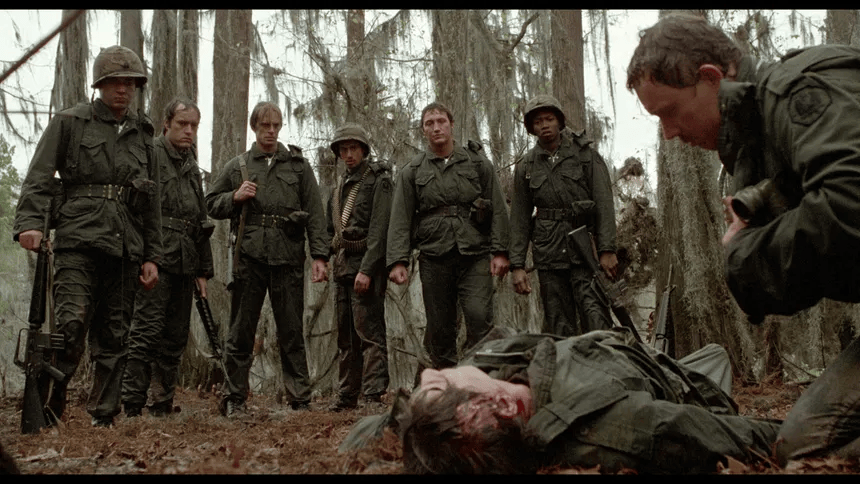
As assholes like the National Guard come into the Louisiana swamps, undisciplined, with too much levity in their system, and open fire on the swamp people with blanks, while the swamp people retaliate with live rounds and start killing them off one by one. So sets the film in motion. A reality I fear we may be living in in the near future, which if some of my personal friends are to be believed, climate change is going to raise the water levels, flood the cities, make everything into a swamp land, while we’re put under control of a fascist government ruled by kikes who want to kill us all. So we may turn out like swamp people defending ourselves against the national guard in the near future if that potential future comes to pass (I doubt the climate change part).
But then there’s the whole viewpoint of empathy. Couldn’t all this be avoided if we empathize with the enemy, and they do the same to us, and are thus able to work out our differences with understanding like some bullshit Gene Roddenberry story? Kiss my ass and fuck empathy. There’s no time for empathy in these times in the land of confusion, our setting doesn’t allow for it. Too many men, too many people making too many problems, and there’s not much love to go around. Empathy would be nice if we have time for it. And maybe in a better society we would. But generally it’s just not worth it, not when there isn’t an ounce of respect and the opposition looks down on you. I myself find it’s not worth the effort to be empathic to most people, as the past hasn’t been kind for my efforts.
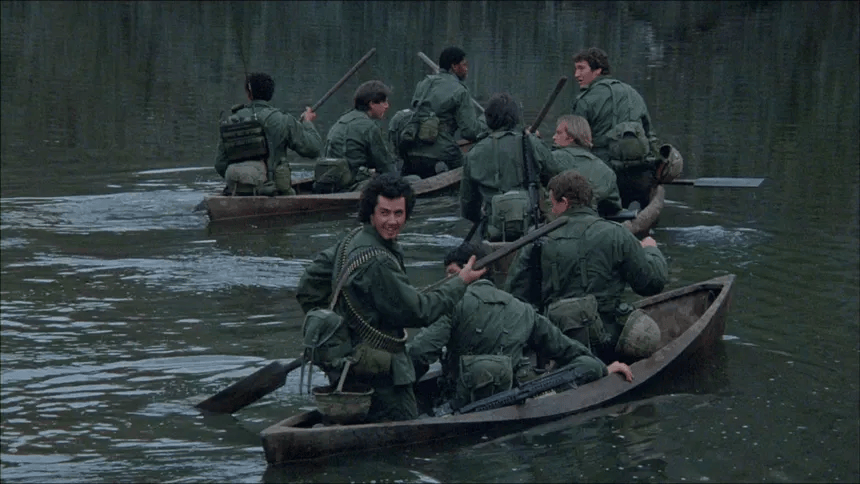
“He possesses levity only because it helps him deal with stress.”
His levity is making others more than stressed. He deserved to drown in the muck for his actions getting so many killed.
“She literally broke her back trying to deliver this 50 pound package to your doorstep because she’s overweight.”
Fuck her fatass and the mother that birthed her. She should’ve had more self control over the number of donuts and soda in her diet. And double fuck her for tossing prior packages so hard against the door it shattered the glass contained in the package. She deserves to have her back broken and die.
“They’re only anti-white because they were taught to be that way in school.”
So was I! Yet I had enough common sense to seek alternative learning to pull myself away from that self-destructive bullshit. If they can’t shape up with their own natural drive and mentality soon enough, they deserve to be treated as irredeemable enemies.
“He’s retarded because he was born that way.”
Well then maybe we should bring back eugenics so there’s less retards spreading their retardation everywhere and pulling advancements down forcing us to cater to them because “it’s the ethical thing to do.” Otherwise retards are going to do something retarded that could eventually cause harm to others (if not themselves), which could result in retaliation lynching like what happened in this movie. At the very least we should look into reducing all the factors that cause retards to be made, from shitty food, shitty drinks, shitty companies ruining good food with chemicals and such, drugs, and women in their mid-late 30s having babies with a higher chance of retardation than those having kids between their late-teens and early 30s.
“This homeless person was a good person once, but hard times and drugs made them into the inane lunatics they are now.”
Sure, we should eradicate the drugs, but these inane-rambling arm-twitching hallucination-shouting syringe-dropping grafftti-spraying garbage-dumping feces-throwing porta-potty-bathing motherfuckers would all be better off dead. They are a detriment to society and themselves with no hope of redemption, let alone capable of becoming a positive contribution to society ever again.
I don’t have the time or the patience to have empathy for so many of these fucking people. It’s too much of a hinderance. It’s easier to just go with the option of viewing them as lost causes that the world would be better off without. Which is why I can’t help but sympathize with the swamp people in this film with how they act against the national guardsmen.
If you think my opinions are radical now, you should see my take on Suicide Club (2001).
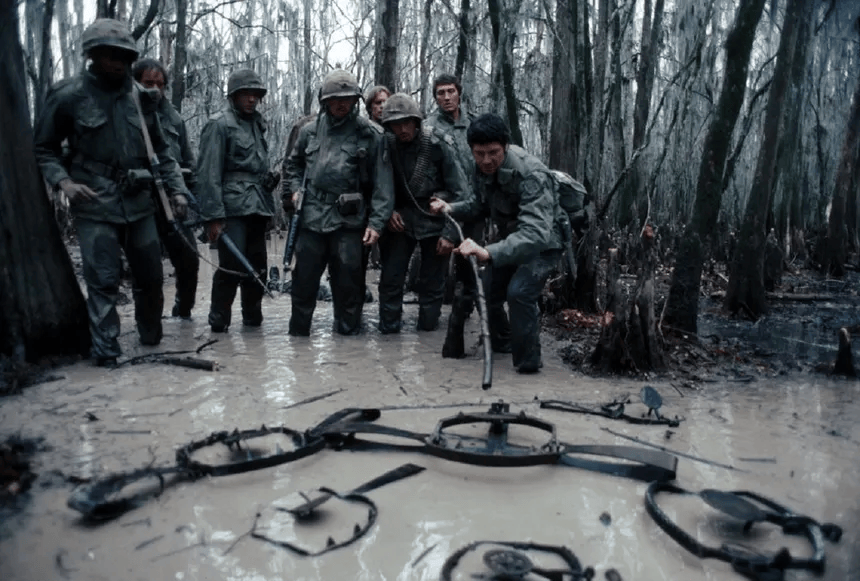
In this film, the national guardsmen don’t speak French like they do in the Louisiana swamps. So like in reality, in addition to a cultural difference between various regions in America, there is also a language barrier. Why are there French-speakers in the swamps of Louisiana (at least in the 1970s)? Good question… let me look that up.
…
…
Long story short, France once had territory in North America (they had their own colonies and immigrants), along with Britain and Spain. Once it got taken over by what’s basically known has the United States today, some French stuck around in the territory, because they were born and raised into it. For all intents and purposes, it was their home. And in the case of this film, I suppose they’re to be a metaphor for the Vietnamese (obviously) about as much as they’re a metaphor for the American Indians. The United States government may be the one that rules and imposes itself upon those lands, but the people who have lived in those lands for multiple generations have their own opinions and their own say. And it could go one way or the other. The way of the American Indians, where they get ass-fucked by the government and are either forced off their lands or have their lands made into reservations (until they’re inconveniently found to be in a land abundant of some resource the government wants). Or the way of the Vietnamese, who kicked America’s ass all the way back to the continent they came from.
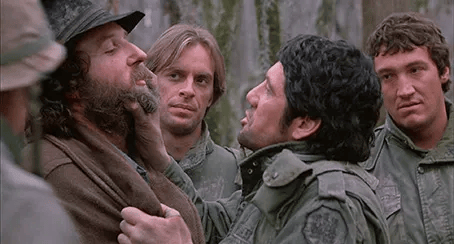
However, the reality of things is never that simple. And the whole grey area becomes apparent in this film when you put a few seconds of thought into it. Why are these National Guardsmen so unprofessional? Being green is no excuse. Apparently it’s because, generally, they tend to meet up for a training exercise once a month at best, if not once every few months. So since it’s no boot camp, of course they’re going to be more casual about the experience. And since a few know each other personally, of course they’re going to be more lax. Why should they take things seriously when it’s just supposed to be a glorified hike when they’re among comrades they do practical jokes with all the time without any serious repercussions? Contrast that with the swamp people who are always wary of the wildlife, the dangers of the swamp, quicksand, and alligators (unfortunately none of the latter are in this film; one could dream of this also becoming a partial creature feature).
“Why’d you paint the cross on your chest for?”
“It’s part of the joke.
“What joke?”
“It’s a corporal joke private.”
[…]
“You know the Avenging Angel and all that.”
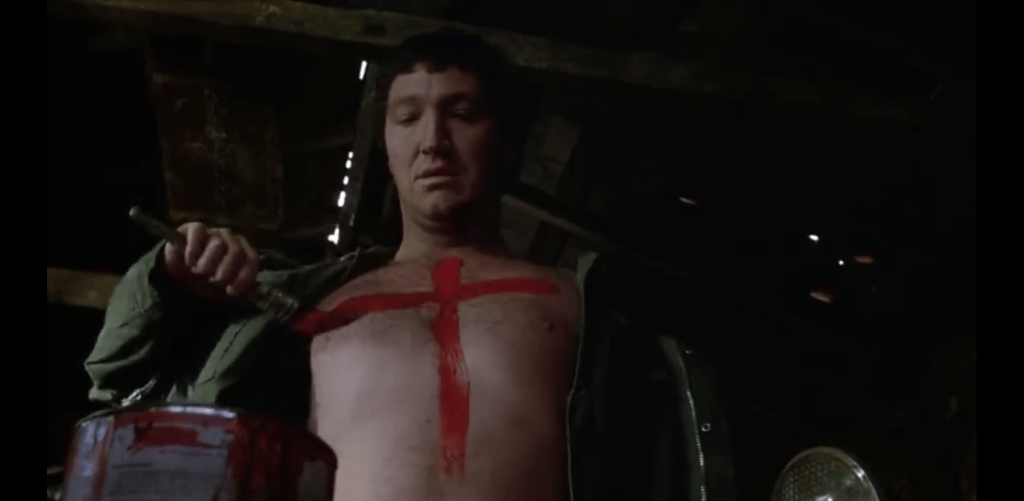
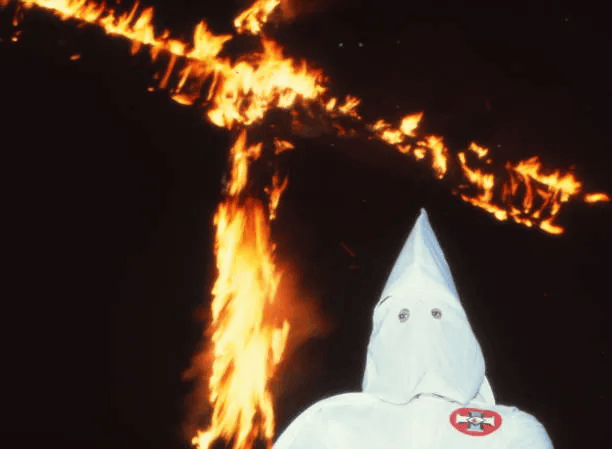
Taking revenge for past wrongs can lead to strange lines of thinking that may seem logical in the moment for the individual, but unnatural to others (if not everyone else). How certain national guardsmen want revenge against the swamp people after one of theirs dies, but some take it far more personal than others, and get fanatical to the point of losing sensible logic. In the case of painting a red cross on his chest, this could refer to either the KKK or the Christians in the Crusades (as usual with a Hollywood film, there is some merit to this, but by-and-large misguided). In any case, there’s two sides to this. How insane and unreasonable certain national guardsmen get, and how unreasonable (and unempathetic) some of the swamp people get, particularly during the final act. But there just isn’t a chance for empathy to enter into things, for the most part. Sure a couple soldiers may wonder what the swamp people are thinking, about their perspective on things, and contrast it with their actions and the actions of the other guardsmen. But it doesn’t apply generally. This is further contrasted with the title of the film. There are the locals in the village who are generally content, accommodating, and ignorant to the state of things, who actually give comfort to the surviving guards (or at least try to, as their paranoia inhibits their ability to have relaxation and allow for some amount of innocent joy). Contrasted with the swamp people who arrive intending the opposite of providing comfort. The revenge intended by the one-armed man as opposed to the revenge by the other swamp men. The film works because we only get the perspective of the guards, but we can speculate, with some implications and evidence, as to how the swamp men generally feel about the situation, and how not all of them are the same (as is the case for the guards).

If you’ve ever seen this movie, you’d know that the point that viewers tend to ponder upon is the ending. Why does it end on that tone, on that feeling of paranoia and uncertainty, or even dread, when it seems as if the last survivors have finally come upon their rescuers? Because for the most part, I thought the film was simple until that point. But upon further reflection, I realized it isn’t. When you take into account the whole empathy and consideration for revenge mentioned above, that’s one thing. There’s also the thing of Fred Ward’s character, even though he was an asshole, he was right to believe that the one-armed swamp man wasn’t all he appeared to be. The other aspect is in regard to the U.S. military itself. At an earlier point, one of the guards runs frantically towards a helicopter flying in the air, only to stumble into quicksand, and sink to his death as the chopper hovers lower towards him while he’s shouting at it for help. An implication that the military is anything but helpful towards its troops under duress. That at the end of the day, they’re not there to help. At least that’s the thematic implication I get from this. But the ending moment, when the final survivors see the military truck coming (which is the same one that drops them off at the beginning of the film), and the helicopter blades are whirling oppressively, it seems like they should be rescued, but there’s something off about it due to their reaction and the film slowing down. It ends on a strangely obscure note. My impression is that the paranoia will never leave these men even upon rescue. Like soldiers suffering from shellshock. Even when rescued and taken out of the jungle, their minds haven’t fully left (as is the case for many Vietnam veterans). Because there were other occasions when they thought they were rescued, but it ended up not being the case, thus they aren’t sure if they should ever let their guard down. But even if they are rescued, they will be taken back to a society with other irresponsible assholes, and a government that doesn’t really give a shit about them.
Although the other fun possibility, as stated earlier by one of the guards, it’s possible that the military truck is filled with those prostitutes that he mentioned was waiting for them at the end. As in the look they give each other at the end is, “Well, under any other circumstance, this would be a great thing. But this is just awkward now.”
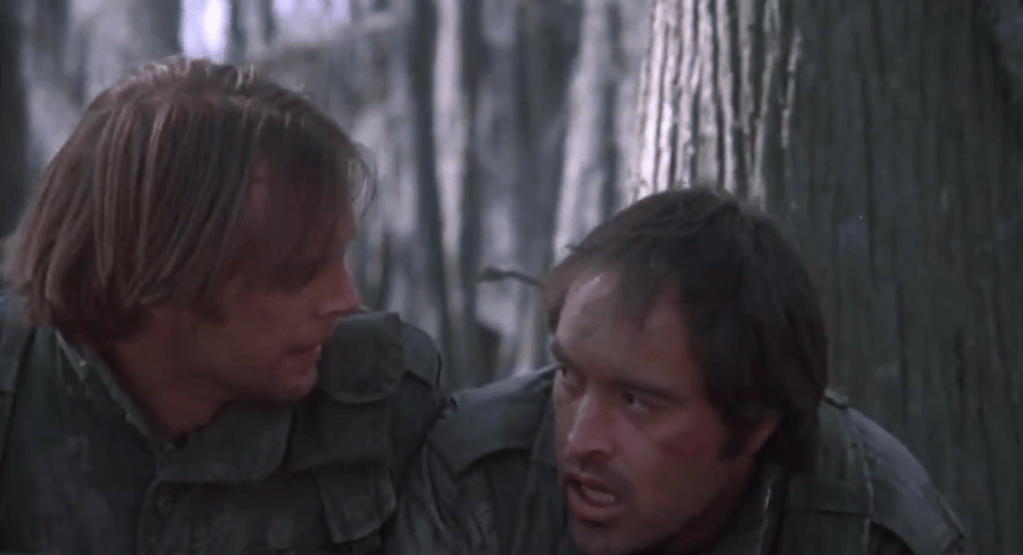
I also like to think of this film as a response to Deliverance (1972) in a similar vane as Sweet Hope Alabama (Lynyrd Skynyrd, 1973) was a response to Southern Man (Neil Young, 1970). While Deliverance generally portrayed the southerners (ie hillbillies) as low-intelligent rapist cretins, Southern Comfort tends to take a more nuanced approach and just portray them as… human. And hell, even the canoe riding at the beginning seems like a callback to that film. Deliverance is about coming into the woods, finding out the locals suck, and the characters coming out worse as a result. Southern Comfort is about coming into the woods, fucking around and finding out with the locals, and the characters coming out worse as a result. The biggest difference is the nuance with the locals, which I argue makes Southern Comfort the superior film. Plus aiming its criticism towards the military, generally, is an overall more accurate message as to what is currently overall more detrimental towards society compared to blaming hillbilly hicks for generally making society worse.
And speaking of 1973 (the year this film takes place in), other interesting events happened during that year.
- The year the Paris Peace Accords officially ended the Vietnam War.
- The year Henry Kissinger is sworn in as America’s first Jewish Secretary of State.
- The year that Roe v. Wade legalized abortion.
- The year the reality television show An American Family premiered on TV, along with The Young & the Restless, and Schoolhouse Rock.
- The year The Rocky Horror Picture Show premieres, along with American Graffiti, The Sting, and The Exorcist.
- The year the American Psychiatric Association removes homosexuality from its list of mental disorders.
- The year the US Supreme court approves equal rights to females in military.
- The year black man Mark Essex’s racially motivated mass shooting in New Orleans comes to an end after he is shot by police.
- The year the first mobile phone call is made.
- The year the US cuts the maximum speed limit to 55 MPH.
- The year the World Trade Center opens in New York.
- The year the Pink Floyd album Dark Side of the Moon is released.
- The year the Soviet Union landed its second rover on the moon.
- The year Aleksandr Solzhenitsyn publishes “The Gulag Archipelago.”
- The year OPEC oil ministers use oil as an economic weapon in the Arab-Israeli War (Yom Kippur), mandate a cut in exports, and recommend an embargo against unfriendly states.
- The year the Provisional Irish Republican Army (PIRA) undertakes its first operation in Great Britain via planting car bombs.
- The year John Lennon and Yoko Ono form a new country with no laws or boundaries, called Nutopia.
- The year Nixon signs the Endangered Species Act into law.
- The year of the Watergate scandal.
Pretty sure at least one of those events is linked to this film in one fashion or another.