
Having played my fair share of mahjong, and having seen the shows Saki, Akagi (short for Touhai Densetsu Akagi: Yami ni Maiorita Tensai), and the more obscure Shin Janki (the first of 19 films anyway), I can safely say that the anime show Saki is complete horseshit. How it gives the impression that there’s a supernatural element to it, or that one can be so damn good at it that she can deliberately cause point distributions to end at a specific amount every game. This is rubbish. Mahjong is a game where players have to adapt to the flow of the game (ie the tiles they draw) and to the strategies of the other players (what kind of hands they tend to go for, what their discards indicate, what their pons and chiis declare about their intentions, if they’re bluffing about the kind of hand they have, etc).

Rated: 3/5
“You don’t have the will to win. You’re only trying to survive. It’s the last thought process of those at the end of their lines in gambling.”
The one anime that capture the essence of this quite well is Akagi. When it comes to the first 13 episodes anyway. The last 13 episodes get a bit ridiculous with the characters in a manner typical of an anime. But to be fair, the last 13 episodes also showcase a very intriguing way of playing mahjong utilizing transparent tiles. But the main villain of those episodes… he was too over-the-top for me. Personally, I would just watch the first 13 episodes of the series, and end it there. Besides, episode 26 ends on a cliffhanger that never gets resolved unless you read the manga, of which the series only covers about 1/4 of.
Akagi is a character who isn’t given much background, but it can be inferred that he lives for the thrill, for forms of high stakes gambling. And not necessarily for money either, money doesn’t mean much to him. For him, it’s more about pride, and shattering that of others’. He is very good at reading people, indicating he comes from an environment where people are taken advantage of all the time through tricks and bluffs and intimidation. At the start, he knows nothing of mahjong. But he is shown to be a fast learner (he has to be adaptable and resourceful to survive where he comes from), and what he initially lacks in game skill/experience he makes up for in catching on to each individual’s playstyle and subtle mannerisms. He even catches on to cheating techniques. Like all games that involve an element of luck and bluffing, being able to read opponents is a vital skill.
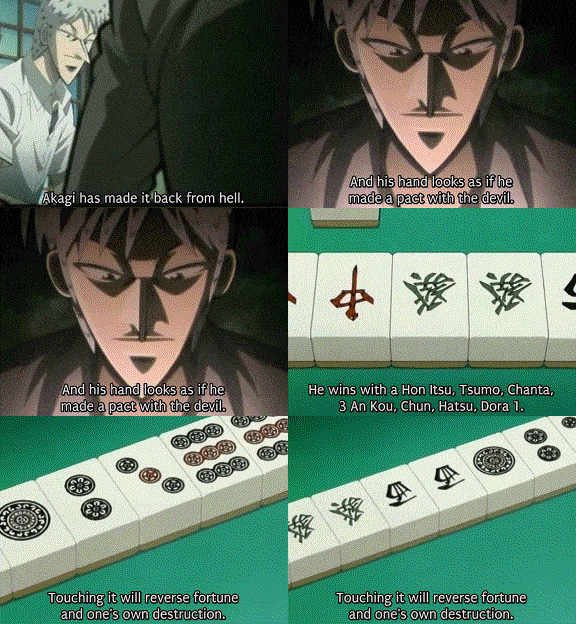
When Akagi reveals how/why he played the way he did during episode 13, the show became freakin’ brilliant. It demonstrates how a master mahjong player plays and thinks. It’s like if a film showed how a poker player figured out the way another player plays, his subtle mannerisms, facial ticks, and body motions that give away if he’s bluffing or not, except with mahjong it’s more complex than that. Additionally, it also showcases the manner in which players can cheat (some very interesting sleight-of-hand tricks).

Rated: 3.5 / 5
“Men will do anything if you can strike them where it hurts.”
Of course, you can’t talk about Akagi without talking about Shin Janki, which is based on true events about this master mahjong player (Sakurai Shouichi) who played for around 20 years (starting in the 1970s I believe) and never lost a major game, in the underground world. I wouldn’t be surprised if Akagi was at the very least inspired by this figure. Unfortunately, unlike those two anime shows, this live action film series is very obscure for Americans. Hell, it’s so obscure, it’s not even listed on imdb. Very difficult to find; and if you do find it, it will be of low video quality. Even worse, you’re likely to find it without any English subtitles. Personally, I have all 19 films, but they’re all bad quality (we’re talking small box television from the 1980s video quality here), and I only have subtitles for 2 of them (thankfully the first film is among them). That all said, this film (currently I’ve only seen the first) is exactly what I would hope for when it comes to a movie with mahjong as a focus (Crazy Rich Asians can kiss my ass, and shove their immigrant message up their own).
The plot of the film is basic fluff. Some rich people try to intimidate Shouichi into playing for them, he refuses, so they practically force him into a game with them where the stakes become high. It’s all typical. But for mahjong players, it’s satisfying just to see a film that is typical but solid, because I’d rather have something like that than something insanely over the top like Saki (I’m still going to shit on that joke of a show any chance I get when discussing mahjong). Plus, there are a few moments worth pointing out. Such as that it shows rich corporate owners and bankers playing mahjong against each other in a private place. I had to smile and clap my hands at this. Because of course guys like that would be mahjong players. Being good at a game where you’re running statistics through your head with each discard and each draw at a rapid rate, being able to read others, and bluffing. It’s a natural talent people of that position are likely to have if they’re into making business deals and such.

That, and another one of those warning signs popping up to remind me that Japan was compromised even back then with the so-called SJW stuff. Tranny appearance marring an otherwise solid film (brief, but still unnecessary). Stuff like that I notice pops up here and there in their anime from the 1980s and onwards, so the brainwashing and acceptance of stuff that upsets the natural order of having a homogenous family via a straight heterosexual family was being jabbed at even back then.
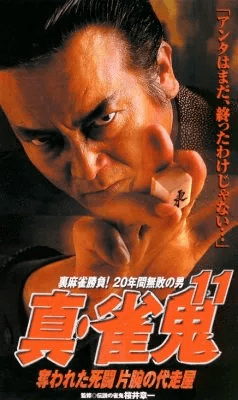
That aside, if you like playing mahjong, it’s worth tracking this film down (maybe even the rest of the film series, depending on how fluent you are in Japanese, if you have access to subtitles, or if you will just do without the subs). It does mahjong better than Searching for Bobby Fischer does chess.
Now I’m not going to explain the rules of mahjong to you fellow readers out there. If you want a rules explanation, there’s a 3 hour youtube video for that (which unfortunately uses a screen capture from that Saki show):
Either that, or read this pdf file of the 2016 riichi mahjong championship rules, which will take less time:
http://mahjong-europe.org/portal/images/docs/Riichi-rules-2016-EN.pdf
In any case, there is one thing I can say about the game, having put over 200 hours into playing it (mostly via Riichi City). I’ll never be at the level of the characters in these shows, not by a longshot. At best, I may be able to eventually memorize how many points I can gain for various hands, but my mind can’t process information as quickly as those people, let alone Asians in general. You mine as well ask me to get good enough to compete against Koreans at Starcraft tournaments.
PS: Strongly recommended blog post: Jankiryuu—Way of the Mahjong Demon, by Daniel Moreno. Which had this quote from the man himself, Sakurai Shouichi: “Mahjong is a bad. But the game itself is not bad—people make it bad. I wanted to do something for this game.”
 The Anomalous Host
Decent entry, although dirtied by the grifter pause in the middle
LikeLike