
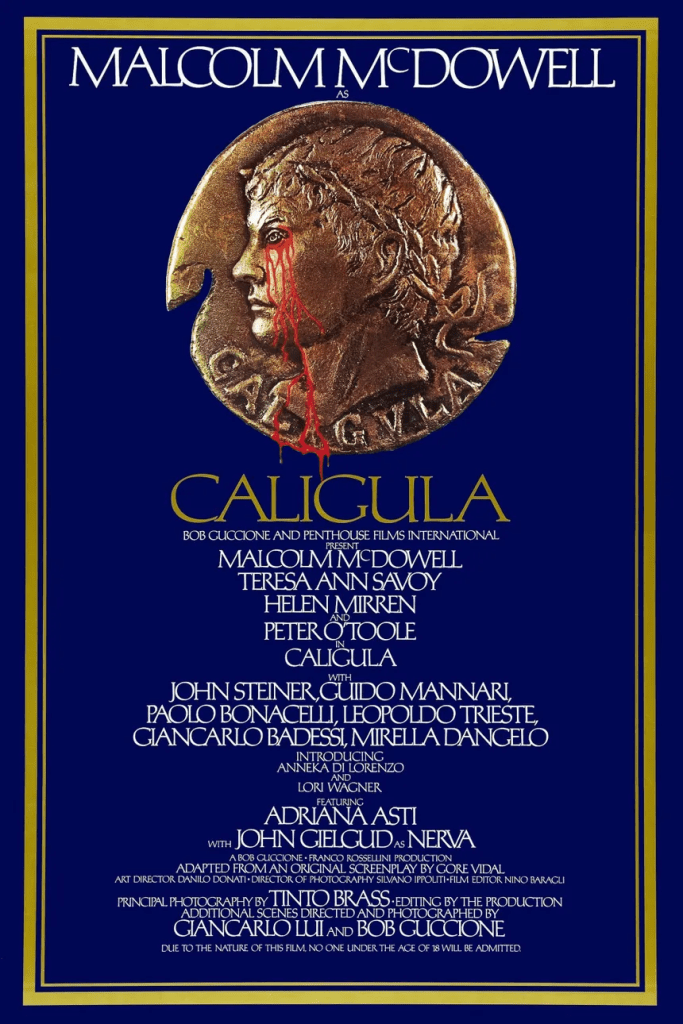
Rated: 3.5 / 5*
* = Rating varies based on version.
It was too perfect an opportunity to pass up hearing about the Ultimate Cut being released of this movie, to motivate me to rewatch the theatrical cut (uncut) prior to viewing that, and then talking about it it after giving my thoughts on Gladiator. But things aren’t that simple. While I have seen both official versions of the movie (and haven’t seen the other less-available versions that are out there), neither one is what I would consider to be the best way to see the movie. Both have their pros and cons.

The original X rated theatrical version deserves its infamous reputation. It earns that X rating in every respect. There’s plenty of nudity and sexual content throughout the runtime, even to the point where it completely kills the pacing at two different points. Anyone who knows about this film’s history knows this is because Bob Guccione, owner of Penthouse (which financed the film), wanted more sexual content in the film, and had extra sex scenes shot, two of which are a bit more obvious than the rest if for no other reason than they last longer than everything else that tends to go for less than 5 seconds each in a montage of debauchery. It made me fast-forward through those moments, making me roll my eyes and go, “Move this along already!”
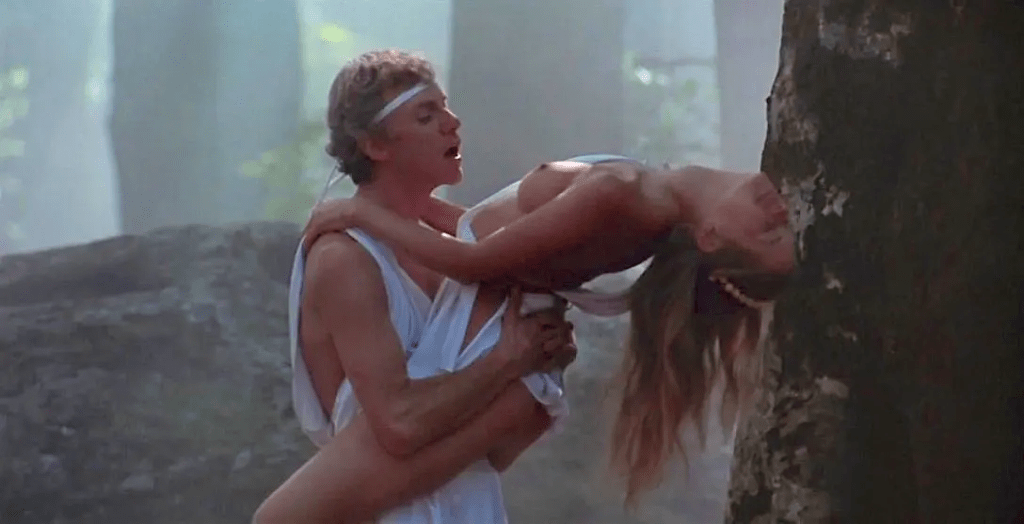
But I digress. In spite of those pace-killing weaknesses, there’s a legit good movie in there. I realized what potential this had when it got to the sequence just after the “invading Britain” scene, where Caligula brings the products of his exploits to a senatorial feast. The moment he uttered the lines, “… they approve of what I do? They must be mad. I don’t know what else to do to provoke them.” It’s at that moment I began to understand his motivations during the last act of the film, why he was doing what he was doing. After his sister dies, he has a death wish. But he wants to go out in fashion, by making a mockery of the Senate, the gods, and the army. He wants to make a mockery of Rome in general, because he despises what Rome is. Hints of this are dropped earlier, such as during the epic decapitation sequence (you’ll know it when you see it), when he says, “If Rome only had just one neck.” His hatred stems from some childhood trauma, primarily as the result of Tiberius’ reign and what he did to Caligula’s family. And this rage comes out in full force during that senatorial feast when he shouts, “Crawl! Crawl! Crawl! I hate them!” Because he hates that the Senate are cowardly sheep who just simply do the emperor’s bidding, which caused an emperor like Tiberius to do things without restriction and going unchecked. This becomes apparent with the music playing over the senate feasting being the same track that plays over the orgy sequence in Tiberius’ palace. So by Caligula declaring himself a god (because he blames the gods for his sister’s death), and intending to provoke the senate and the military to the point where they kill him, he gets his wish for death granted, he makes them kill a god, and he makes them grow a pair of balls so that they become capable of killing a mad ruler in some small hope that this will keep future emperor’s in check and prevent them from being both like him and like Tiberius.

The Ultimate Cut goes for a slightly different theme. It’s much more anti-god than the theatrical version, particularly with the inclusion of this sequence where Caligula is smashing statue heads (representing himself) and shouting, “You don’t exist!” meaning that there are no gods. This is followed up with a scene where Caligula wanders a room and ponders. Since this follows the aforementioned scene, it’s implied he’s searching for meaning in his life, and finding none. As in, what was the point of making himself a god in order to mock the gods if he’s to decide afterwards that gods don’t really exist? That he’s now just doing this exclusively just to make a mockery of the gods just so that everyone else takes the idea of there being gods less seriously? By doing this the film winds up restricting the various interpretations that are to be had from viewing it, by focusing more heavily on Caligula’s motivation to go against the gods he so closely followed up until his sister’s death, rather than just making that one part of multiple things he’s trying to accomplish.

But that’s not to say the Ultimate Cut doesn’t have its merits. There are some scenes restored that are much appreciated (particularly giving more build-up to the “Crawl! Crawl!” moment). There are alternate camera angles for various sequences that are an improvement over the theatrical version. Some of the new music isn’t half-bad. Removal/replacement of various nude shots and porn scenes. And thank Christ the whole first act is told in chronological order now (that’s my biggest caveat with the Theatrical version next to the excessive porn).
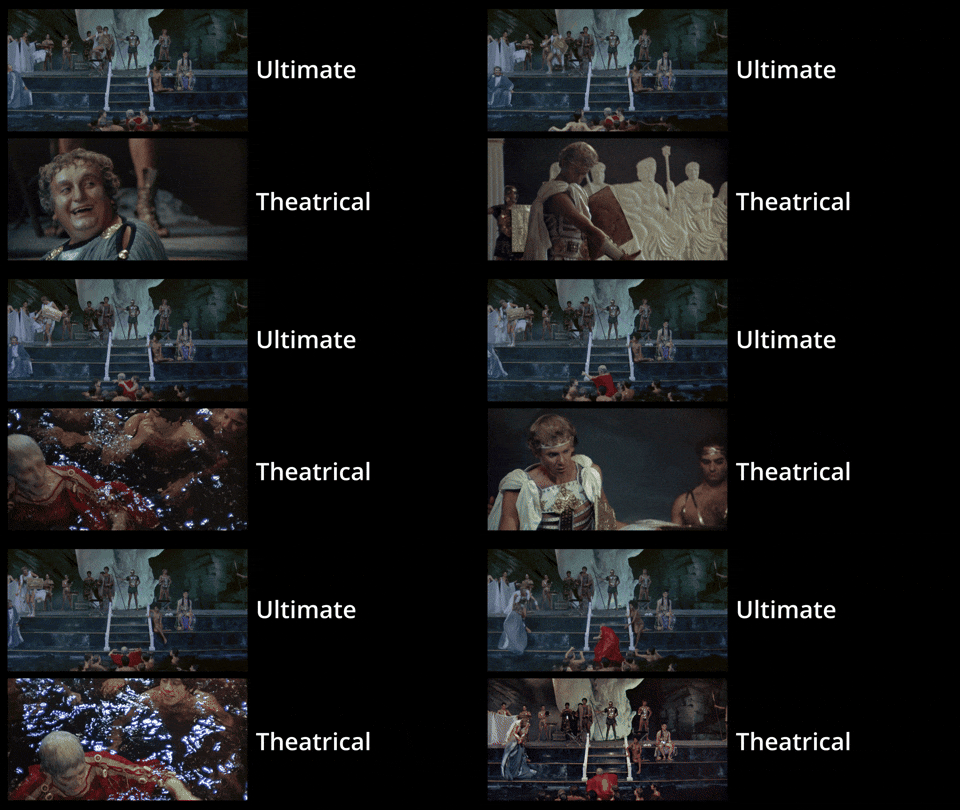
But having seen the Theatrical version, the Ultimate Cut proves to be a very frustrating experience. There are times when the alternate camera angles are inferior to the ones used in the theatrical version; particularly when it goes more for a glorified stage-play view by showing everything and staying at a distance, and not focusing on close-up of a character’s face, or a specific character’s action, when it should. It’s like it wanted to utilize alternate camera angles at times just for the sake of showing alternate camera angles, end result be damned. Replacing the original music with the new score is mostly a bad thing (especially for Drusilla’s death; that’s borderline sacrilegious replacing that score). And how they did the final sequence annoyed the hell out of me compared to the theatrical version which executed it perfectly.
The Ultimate Cut frustrates me because they had everything needed to make the best version of the movie, but it ends up being two steps forward, two steps back. In fact, I’d say it ends up going half a step back further because some of the changes harm the film’s message. Best example being the senatorial feast sequence, which I stated earlier in the theatrical version had that music playing over it that matched the orgy music from Tiberius’ palace earlier in the movie to imply a connection which in turn gives more implied motivation for Caligula and insight into his past. Decisions on which camera shots to use aside, replacing that music with something more generic that offers to link to that earlier orgy sequence just kills that significant development.

So I ended up making my own personal fan cut of the movie to get the best of both versions. It’s not perfect because, you know, differences in color tone between versions, audio transition imperfections. But at least now I have something that shows what this film could’ve been. And it did prove interesting making this extensive fan cut, as it becomes apparent how important camera angles and close-ups (or lack thereof) are for making scenes effective. But the one aspect of this fan cut that caused me to do some pondering is the role of Proculus. It’s amusing because the one thing both cuts have in common with this guy is his wedding sequence. There’s a sequence with him before that which is absent in the Theatrical Cut, and a sequence after which is absent in the Ultimate Cut. For a while I strongly considered leaving both sequences that come before and after the wedding completely out of my cut, only to realize this removes the aspect of Caligula showcasing how violent he can be. I really wanted to include the later sequence primarily just to have Caligula say his lines regarding the fallacy of loyalty to a corrupt regime, but I also had to justify the bloodlust this sequence gives Caligula. Because this bloodlust side of him pretty much goes away after his sister dies. Not once does he go up and start torturing senators, acting violent towards other soldiers, etc. He’s more tame by comparison, utilizing his passion and frustration in other ways. So I thought eliminating his more violent side from the first two acts of the film would be a good idea if he wasn’t going to be that way during the third act, thus making him less of a murderous psychopath, but no less of a sexual deviant.
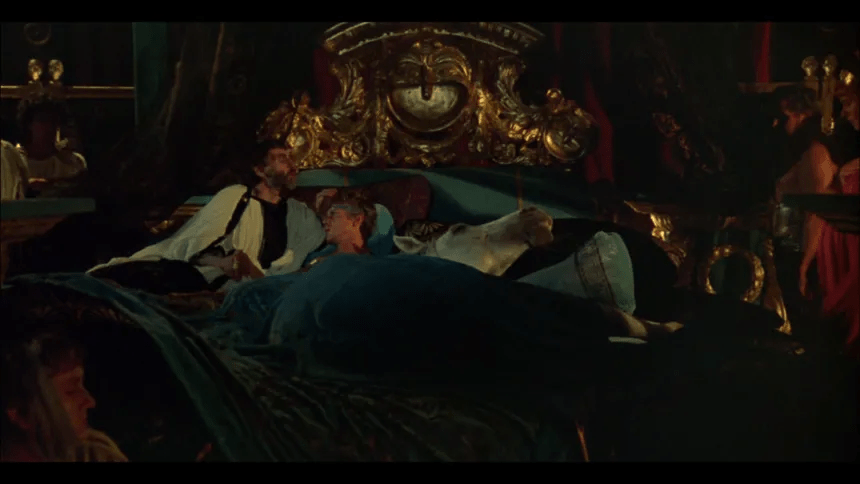
Maybe he fucked the horse.
Then it finally occurred to me how those extra Proculus scenes could work. Have all of them take place before the fever portion of the movie, and have a little image of Proculus pop up during Caligula’s fever-induced dreaming (along with Macro and Gemellus) to imply that he killed him (and the others) because of his paranoia that they would kill him someday; a paranoia fueled by his justifiable fear that Tiberius would try to have him killed. Thus his fear of death drives him to commit violence upon others who don’t deserve it (well… maybe Macro did, but that’s open to interpretation). But I also positioned Proculus’ last scene immediately after the sequence where Caligula slaps his sister and cheers at Caesonia’s dance, to imply that Caligula also resorts to violent acts due to frustrations he’s having with his duties as emperor, and due to frustrations with his sister telling him he shouldn’t do something, or is wrong for doing it. So thus, once his sister dies after he prays to Isis to take his life instead of hers (an instance of him losing his fear of death for the sake of a cause that is that important to him), he loses his fear of death and goes to welcoming it. He also becomes less frustrated with his duties as emperor because he just stops giving a shit, as he views the whole political scene as a joke. Thus he loses two factors that motivated him into doing violence.

I also repositioned the sequence where he gets bored quickly of the monotony of stamping his seal on some law that is to be passed (while not even bothering to read any of the laws he’s passing) to go immediately before Proculus’ wedding. Partly for indicating he’s taking some frustration out on Proculus, but also so that it’s more obvious that there’s a correlation between laws being passed and citizens being violated (ie taking it up the ass) by those laws. You know, like in our present reality.
When Rome was just a city and we were just citizens we’re known to one another. And we were frugal good disciplined and dignified. We had to be. Then we conquered the Earth. […] We found the world to be wealthy. So we plundered it, and lost our true character. The Romans I rule are not like we were. They lust. They lust for pleasure and power, money, the wives of other men. — Tiberius
That’s what I like about this movie. It’s very relevant to our current age and the society we live in. It highlights Rome as a place fallen to people who have given into primal pleasures with little to no restraint. Sexual deviancy, drunkenness, violence, among other factors of societal decay. Caligula, a flawed man, flawed due to the trauma of his upbringing, due to the environment he was raised in, constant paranoia of being killed. He eventually directs his wrath against those more directly related to the cause of the decay: the Senate. Which made me happy to watch this after Gladiator because this stands in stark contrast to that movie. In Gladiator, the Senate tries to keep rule and order and decency amidst the rise of a morally corrupt Emperor. In Caligula, both the Senate and Emperor are corrupt, though in Caligula it’s less about the Senate’s corruption and more about how they’re mindless sheep easily intimidated into doing things (which isn’t too far off from reality in my opinion).
One last note regarding a particular sequence that’s new in the Ultimate Cut. As stated earlier, there’s a scene where, for the first time, Caligula says nothing, and is merely walking around contemplating something in a room that’s mostly empty aside from some staffs with Roman medals and writings on them. The Ultimate Cut implies he’s searching for meaning and finding none, just as there is nothing of meaning for him in this room; implied because this immediately follows the sequence of him destroying statue heads and stating that gods are not real. In my cut, I removed the head-bashing sequence altogether to make this long silent sequence more ambiguous. Because when it’s ambiguous, it’s more open to interpretation. While one could interpret it as Caligula trying and failing to find meaning here, there’s another interpretation I’d like to think this sequence has (which is only possible with the removal of the “bashing statue heads” sequence). I’d like to think that, in the one and only scene where he’s silent, he has come across something that he doesn’t want to mock; that there’s something pure there that he actually respects. But he looks sad because it represents an aspect of Rome’s purity that he wants to have more up, but there’s too much societal/political rot all around for that to ever happen in his lifetime, and there’s nothing he can do about it, especially with the path he’s taken. Or maybe it’s him realizing he’s missed an opportunity to be a good emperor who could rule well and actually make Rome better. Or maybe he’s considering that he may not be killed off as soon as he would like, and he may have to live with being an emperor who acts like one, bears more responsibility, and actually leads like he gives a damn; but being a responsible leader is something he fears more than death at that point. In any case, he’s not happy. Thus the transition from the “May he be happy,” line from a prior scene is linked to this, just as it is linked to Tiberius killing a drunken soldier earlier on in the film by uttering the line, “Now he is happy,” after killing him. Like true happiness can only be found in death. Either that or it’s a twisted sense of humor indicating the grimace made while one is in pain and dying can look like a smile in some circumstances.

Anyway, there’s a decent film to be had here. You just have to have a tolerance level for an abundance of nudity and sexual content. Some people are outraged that something like this even exists, both when it came out, and today. That the debauchery in the film should never be shown, even if it made to prove a point. To that I say a film like this wouldn’t be made if society wasn’t already headed towards a state of debauchery similar to that shown in the film, if not already in it. Otherwise, this definitely wouldn’t have been made, not like this. But since it has been made, and since anyone whose been paying attention has seen the direction society is going, mine as well as make the best of it and appreciate that at least a film with such debauchery in it has an anti-debauchery message to it… to some extent. Though it certainly isn’t anti-incest… another element that makes it stand in sharp contrast to Gladiator.

And then she really got into it.
 The Anomalous Host
There is a major hypocrisy with both how certain people criticise nudity in entertainment and how sex and nudity is depicted in entertainment including Caligula. For example, nudity and sex is seen as wrong and needs the NC-17 or X rating, but yet a man gets shot and killed in a 1930s movie and that’s no big deal. With a movie like Caligula, the gory scenes are treated second to the orgies in terms of factoring the film’s notorious reputation.
Now i understand that in Ancient Rome, orgies was something that was put together by the elites and those events were a symbol of the elites narcissism and status. But that doesn’t mean that it’s the most EVIL thing about Ancient Rome. It seems that for so long, sexuality is so excessively vilified in the developed world that Cinema and the ratings systems to a degree are used to try to convince everyone that the human body and love making needs more censorship than violence. Don’t you think there’s deranged reverse psychology there? That violence is more accepting than sex?
I am not trying to sound politically correct. I am not against showing violence or nudity and sex in film. Art is meant to represent the human condition, and Sex and Violence is really the two main representations of that: Life & Death. But it’s ridiculous to say the least. I wonder if you have any thoughts on this because i do have more things to say even if it’s not straight away.
LikeLiked by 1 person
The issue is that youth tend to get a hold of it one way or another. And long-term exposure to erotic material tends to do bad things to young developing minds (as does drugs). But getting deep into the topic of violence and sex affecting one’s mental faculties is opening a big can of worms, where there’s a lot of grey area and no simple answers.
But putting that aside, I do see it as hypocritical; assuming these films are only viewed by a mature audience, as they should be. So long as these overtly violent/sexual acts are portrayed with purpose (ie something other than stimulating the viewer’s libido or adrenaline and such). In the case of this film Caligula, putting aside the fact that Guccione inserted extra unneeded pornographic scenes that exist primarily just for the sake of porn (to the detriment of the film, primarily in terms of pacing), the sexual stuff does serve a purpose. It’s practically laid out plainly with the speech Tiberius gives, which I quoted in the review. That Rome wasn’t always like this, but it eventually devolved into this state of sexual depravity (with him ironically being a big part of it all). So naturally this stuff should be in full-on display. My initial thought was that it should serve as shock-value, to demonstrate something that should be avoided in society. But since society is more or less heading that direction (one could argue it had already reached that destination during the 70s), the secondary thought is that the film subtly mocks this debauchery. Caligula is one who was raised in this environment, and as a result he makes for a poor leader who cares far more about fun and games than about responsibility as a ruler.
One could argue the film goes too far with it. I agree with that when it comes to the Theatrical Cut. But there are other films that are just as bad about it, even if not as explicit.
So in a nutshell, yes, hypocritical.
LikeLike