


Gladiator rated: 4.5 / 5
Cat People rated: 4/5
So I initially wanted to talk about how Gladiator was one of those films that allowed the decade after the 90s to open with a bang (along with Requiem for a Dream, American Psycho, Snatch, O Brother Where Art Thou, Crouching Tiger Hidden Dragon, Traffic, The Patriot, Meet the Parents, Pitch Black, Erin Brockovich, Final Destination, Sexy Beast, and Quills, to name a few). Redefined the action genre in a way that hadn’t been done since Speed (1994), and inspired just about every historical film set in Rome that came afterwards (including the HBO series Spartacus). And was the last great thing Ridley Scott made next to Black Hawk Down (2001). Gladiator has aged magnificently, even if it seemed to have established this action-centric blueprint model amidst a serious drama.
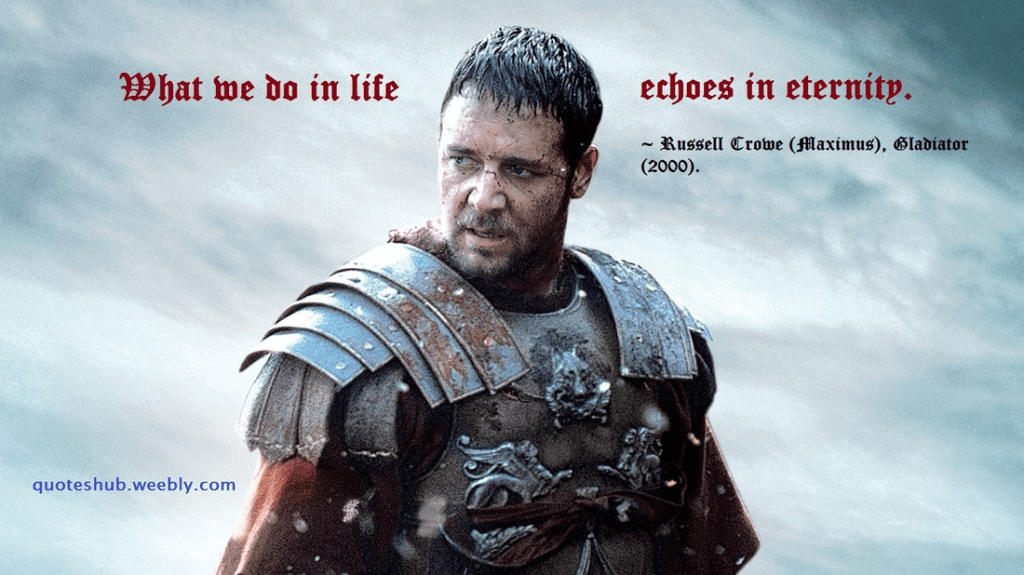
It’s funny to think about, as it seems like a lot of films that were the first of their kind, the first to inspire films to be made one way or the other, end up doing them better than most of those that follow. Like how Jurassic Park (1993) did CG better than a lot of films that came after. It’s one of those things that made me realize I had no idea how good I had in back in my youth. I didn’t know that things weren’t going to get much better than this. How could I know? The stakes of film-making were continuously getting raised as I went through the 90s and early 2000s, which was a time of upbringing and youth that would spoil me as much as set my standards sky-high. Only to realize a little over a decade later that the time for raising stakes of film technology and writing quality was over. I lived through the peak of the bell-curve, and am now in the downward trend. You can disagree all you want, but we should all be honest with ourselves and admit that the golden age of cinema was between the late 70s and mid-2000s. That’s 30 solid years of the greatest films ever made (not to say there weren’t stinkers, but at least they had high points, unlike now where we can’t even get that for one single fucking year). Nowadays everyone wants to recapture the lightning-in-a-bottle moments of those times. They want to remake and/or reboot everything, assuming they don’t resort to sequels first. Of course, the 80s was guilty of this too. But there’s a big difference. The 1980s could get away with it because they had technology that put everything that came out prior to shame (and puts a lot of modern CG effects to shame as well), and still had plenty of honest-to-God talent that poured their heart and soul into the film. Sure there was subliminal messaging that tended to act against our best self-interests (as has been the case since the 1930s), but these films had ways of making up for it. The 2020s has the technology, but doesn’t have any heart and soul when it comes to utilizing it; let alone the talent to make up for the brainwashing that is far more blunt than it was subtle in the past.

Take the 1982 Cat People film for example. Clearly a remake of the 1942 original, with the same concept regarding a human being able to shape-shift into a panther (fuck you Marvel), or cougar, or leopard, whatever. While the original is lauded for being minimalistic by utilizing sound to create tension and showing virtually nothing until the very end of the movie, that doesn’t age it very well for me. It’s fucking dull, and does not make the most out of its low budget the same way The Blair Witch Project (1999) does. Maybe with better direction, and a little more visual teases it could’ve worked, but it comes off as so bloody cheap and droll (in a bad way) to me. The remake makes use of its budget, and of the decade where there’s less restraints when it comes to on-screen violence, nudity, and sexual content, by giving us plenty of all of the above. Plus some indications of incest, which should have hentai-lovers frothing at the mouth.

Because the 1970s-1980s were the wild west decades when it came to film. The 70s when they could do whatever, but didn’t have the budget or maturity often enough to make as many hits as they could’ve. The 80s when that maturity finally came, but there were still those too overambitious who made cheap knockoffs that were destined for only being remembered as a VHS tape you may have rented at a video store (back when those existed) where the best thing about them was the box artwork. But when their films hit, they hit really fucking hard. The 90s, while I have a fondness for it and its wacky zany attitude, tended to have a leash placed upon its films that made them lose the edginess achieved during those prior decades (just look at how the MPAA butchered films like The Crow, Hard Target, Night of the Living Dead, etc). The 2000s was a decade that grasped how restrictive the MPAA was, and tended to know how far they could push things and have fallback plans regarding how far back they could pull the violent/sexual content. So in Gladiator, we’re allowed plenty of bloodshed and decapitations. Hell, we even see a Tiger get stabbed with a sword.
In Cat People, since a woman has to be the one to kill the panther, obviously she can’t use a sword to stick into its throat. She has to use a shotgun… to blow it away. So we get a little female empowerment along with an endorsement on why guns are awesome and useful, and fuck anyone who says otherwise (like you, Europe). Plus Annette O’Toole had to do something to make up for the fact that only her tits were worth revealing compared to Nastassia Kinski’s total package (Europe has America beat in that department).
While Cat People may not have decapitations, it does have a highlight moment of a guy getting his entire arm ripped off; and you see it all, with bones sticking out of the shoulder and everything. None of that would be done in the 1940s, and you can’t get that today without some shitty CG effects making it happen (which will never look as convincing as the practical effects in this 1982 film). Gladiator at least gets the violence aspect right by utilizing a combination of practical effects and CG, relying more on the former than the latter (the latter mostly used for background effects and green screen more than anything else).
Back to the hentai mouth frothing subject: incest. Both films have it. Gladiator has an emperor who lusts after his sister. Cat people has a priest brother who lusts after his sister. Both utilize a man who is in some position of authority recognized by others who abuses it in a perverse fashion (though, in all honesty, I still have a hard time accepting Malcolm MacDowell’s role as a priest who also kidnaps girls, fucks them, and then kills them, and has a secret dungeon for doing this; my mind can’t process this). And in both films, neither succeeds (sorry hentai fans; you should go back to the ecchi genre and get blue-balled again).

After watching Gladiator, it’s more straightforward with its messaging. Aside from the story of revenge, there’s some highly amusing and all-too-relevant political messages. How the emperor wishes to win over the people he rules by giving them incredible showcases of entertainment at the coliseum, which will come at a great expense down the road. The food and games come at the cost of the future, of going into debt and selling off supplies of necessity Rome will need to feed its people and keep them alive and content. Short term fulfillment at the expense of long-term stability. Let those who live for today have their fun now so that those who will live tomorrow can foot the bill, which they may not be able to pay.
One moment I found to be an unexpected, albeit pleasant, surprise, is hearing the Emperor’s sister state this when she’s talking to Maximus, after being told she’s a strong woman: “I am tired of being strong.” Something that I’m sure a lot of feminists are eventually going to say to themselves. No one wants to be strong and independent, but alone. Sooner or later, women are going to want some kind of companionship, and more than one moment where they can not be strong and let their guard down, to actually trust someone enough to where they either don’t need to be strong around them, or that they can be strong for her.
The political ploys and paranoia done in this film between Commodus and the Senators provided a great level of intrigue and depth to contrast with the more apparent surface-level action that happens in the arena. Though that’s not to say the arena battles didn’t have their share of depth either. It’s about how the public can be so manipulated, how they can find favor with one man due to how he performs, how they can make one a popular celebrity if talented enough. How a popular man can make a crowd turn against an emperor (and an empire). How quickly the crowd can change the balance of power based exclusively on how they’re entertained. Which is probably why nowadays those in power have safeguards in place where they can carry on regardless of how unpopular they may become. And, after all, the public tends to have a short-term memory. As implied at one point with regard to the popularity of a sincere figure, “He will be forgotten in a month.” How true that is today when it comes to news-worthy events and the actions taken by various political figures (or even corporations).

With Cat People, it’s a bit more difficult to know what to think at the end of it. At least initially. Upon further reflection, I find the last 20 or so minutes of this film to be absolutely unintentionally hilarious. A girl is on the phone with her (ex?) boyfriend telling him that she thinks this girl he has the hots for is trying to kill her, but he blows her off when he sees the hot girl giving him the, “Have sex with me,” look and stripping in front of him.
“She’s trying to kill me!”
“Can’t worry about that right now. I’m about to get laid.”
And then of course she wants him to “free” her by having sex with her. So he does this by tying her up, fucking her, and then putting her in a cage. Which makes the lesson of the movie be that once you unleash the animal within a woman, you need to tame her by caging her, which is a metaphor by making her a housewife, getting her into kinky sex, and telling that bitch to make you a sandwich when necessary.
Of course, that’s not the only plausible interpretation of the ending. It can also be about how losing your virginity can make you into an animal whose hunger can easily become uncontrolled. Which can lead you into a downward spiral of continuous lust fulfillment and a power trip where love is less of a concern than the next companion you will have only to discard it after it is used until you move onto the next one, and the next, and on and on. A warning about what kind of women can be present in society (men too), which can lead to unhealthy (if not fatal) relationships which can lead to extremes of toxic feminism and toxic masculinity, the former of which leads to stuff like MGTOW and whatnot, the latter leading to women seeking wealthy men whose riches they can inherit after they become companions and then wait until he dies (or something).
Or just some basic tale acknowledging the animal within us all. An animal that craves violence and sexual depravity. Just as we do, or else we wouldn’t be watching and enjoying films like these. And while giving into the animalistic urges within us grants a feeling of liberation, it also threatens to imprison us within a cell of our own making, a slave to our desires.
PS: The other thing about Gladiator, when it comes to crowds making one popular, there’s a mediocre film titled Blood and Sand (1941) that I consider to be a companion piece regarding the cheering crowds. A warning about how crowds can drive celebrities into doing things they wouldn’t want to do. How crowds are incapable of acknowledging the hell their favorite celebrities go through to entertain them (physically and mentally). Because at some point, a man has to live for himself and his family, and not others who love the entertainment he provides more than the man himself. Because crowds lack empathy, because they cannot afford to have empathy when it comes at the expense of entertainment.
PPS: Cat People has one of the most 80s soundtracks ever. And enough nudity to give Lifeforce (1985) and Quest for Fire (1981) a run for their money.

 The Anomalous Host